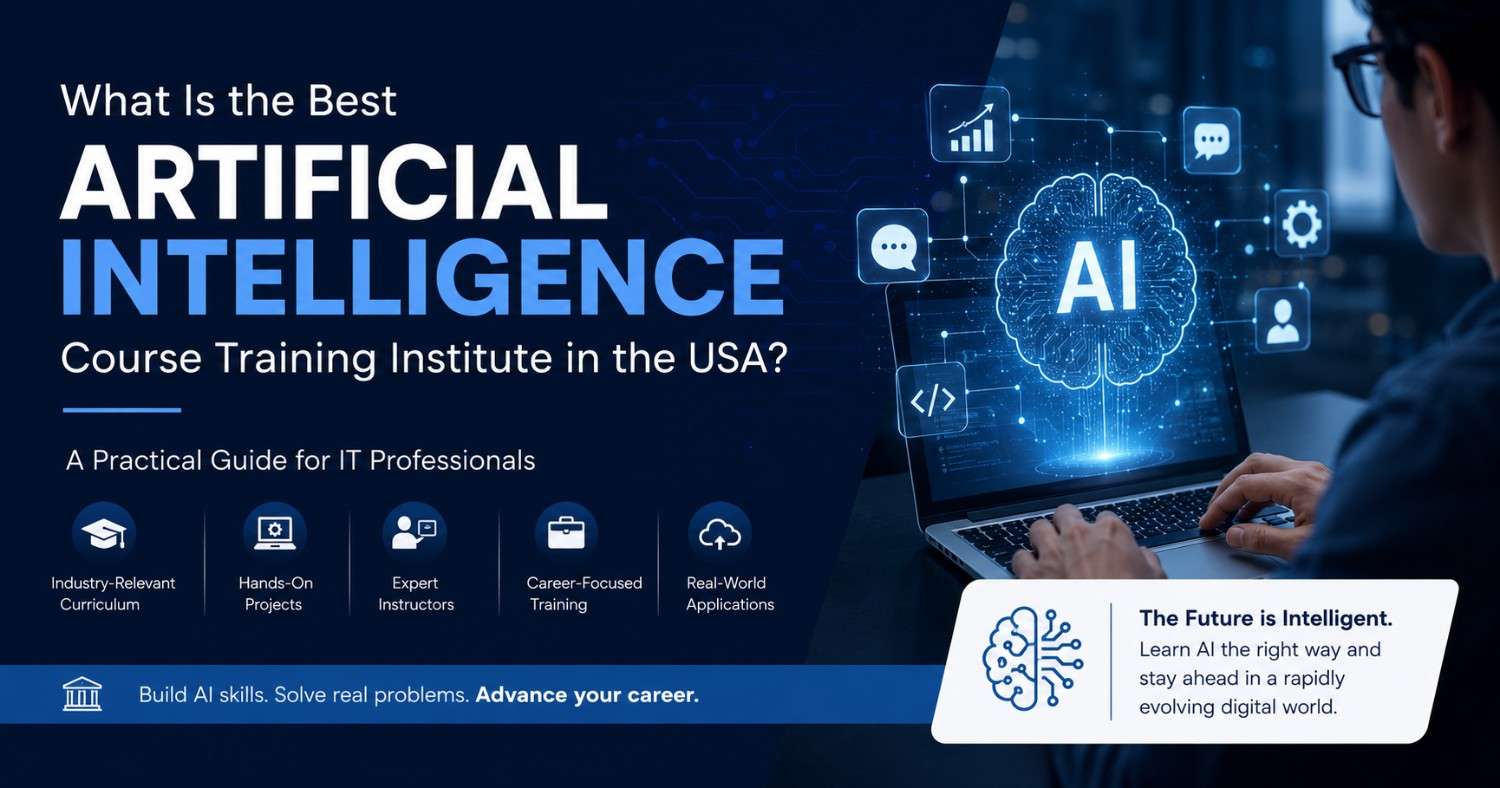
The best artificial intelligence course training institute in the USA is typically one that combines foundational AI concepts, practical projects, industry-relevant tools, experienced instructors, and structured career-oriented learning. The ideal program should help learners understand how AI systems are developed, deployed, monitored, and used in real business environments.
Artificial Intelligence (AI) has become an important technology across industries including software development, healthcare, finance, manufacturing, retail, cybersecurity, and business analytics. As organizations continue to integrate AI into business operations, many professionals are seeking structured AI training to build practical and job-relevant skills.
What Is Artificial Intelligence?
Artificial Intelligence (AI) refers to the development of computer systems that can perform tasks that normally require human intelligence. These tasks may include:
- Learning from data
- Pattern recognition
- Decision support
- Natural language processing
- Computer vision
- Predictive analytics
- Process automation
Modern AI systems are often powered by machine learning algorithms, deep learning models, large language models (LLMs), and data-driven decision-making frameworks.
AI is not a single technology. Instead, it is a collection of methods, tools, and techniques used to solve business and technical problems.
What Is the Best Artificial Intelligence Course Training Institute in the USA?
There is no universally “best” AI training institute for every learner. The most suitable institute depends on factors such as career goals, technical background, learning style, and desired specialization.
When evaluating an AI training provider, professionals commonly assess the following criteria:
| Evaluation Factor | Why It Matters |
|---|---|
| Industry-Relevant Curriculum | Ensures practical and current knowledge |
| Hands-On Projects | Develops real-world implementation skills |
| Experienced Instructors | Provides practical guidance and industry context |
| Tool Coverage | Exposure to commonly used AI platforms |
| Flexible Learning Options | Supports working professionals |
| Career Support | Helps with interview preparation and portfolio development |
| Practical Assessments | Validates applied knowledge |
| Updated Content | Keeps pace with evolving AI technologies |
A high-quality AI course should focus not only on theory but also on implementation, deployment, governance, and business applications.
Why Is Artificial Intelligence Important for Working Professionals?
AI is increasingly becoming part of everyday business operations. Professionals across technical and non-technical domains are expected to understand how AI systems function and how they can support organizational goals.
Common business drivers for AI adoption include:
- Process automation
- Improved decision-making
- Customer experience enhancement
- Fraud detection
- Predictive maintenance
- Data analysis at scale
- Resource optimization
For working professionals, AI knowledge can support career growth by expanding technical capabilities and enabling participation in AI-driven projects.
How Does Artificial Intelligence Work in Real-World IT Projects?
AI projects generally follow a structured workflow that transforms raw data into actionable insights or automated outcomes.
Typical AI Project Workflow
| Stage | Description |
|---|---|
| Problem Definition | Identify business objectives |
| Data Collection | Gather structured and unstructured data |
| Data Preparation | Clean, transform, and validate data |
| Feature Engineering | Create meaningful input variables |
| Model Selection | Choose suitable algorithms |
| Model Training | Train using historical datasets |
| Evaluation | Measure accuracy and performance |
| Deployment | Integrate into production systems |
| Monitoring | Track performance and drift |
| Optimization | Improve based on feedback |
Example: Customer Support Automation
A company receives thousands of customer requests daily.
AI implementation may include:
- Collecting historical support tickets
- Training an NLP model
- Categorizing customer issues automatically
- Routing tickets to appropriate teams
- Generating suggested responses
This reduces manual effort while improving response consistency.
What Skills Are Required to Learn an AI Course?
Many AI training programs are designed for beginners and working professionals. However, certain foundational skills can make learning easier.
Technical Skills
Programming
Common programming languages include:
- Python
- SQL
- R (less common in enterprise AI)
Python remains the dominant language because of its extensive AI ecosystem.
Mathematics
Basic understanding of:
- Statistics
- Probability
- Linear Algebra
- Calculus concepts
Most practical AI courses focus on applied understanding rather than advanced mathematical theory.
Data Analysis
Professionals should be comfortable with:
- Data visualization
- Data cleaning
- Exploratory analysis
- Reporting
Problem Solving
AI projects require:
- Critical thinking
- Pattern recognition
- Logical reasoning
- Business understanding
What Tools Are Commonly Used in Artificial Intelligence?
AI professionals work with a variety of development, analytics, and deployment tools.
Popular AI Tools and Platforms
| Category | Common Tools |
|---|---|
| Programming | Python, R |
| Data Analysis | Pandas, NumPy |
| Machine Learning | Scikit-learn |
| Deep Learning | TensorFlow, PyTorch |
| Visualization | Matplotlib, Seaborn |
| Databases | MySQL, PostgreSQL |
| Cloud AI | AWS AI Services, Azure AI, Google Cloud AI |
| Version Control | Git, GitHub |
| MLOps | MLflow, Kubeflow |
| Generative AI | OpenAI APIs, LangChain, Hugging Face |
Most enterprise AI teams use combinations of these technologies depending on project requirements.
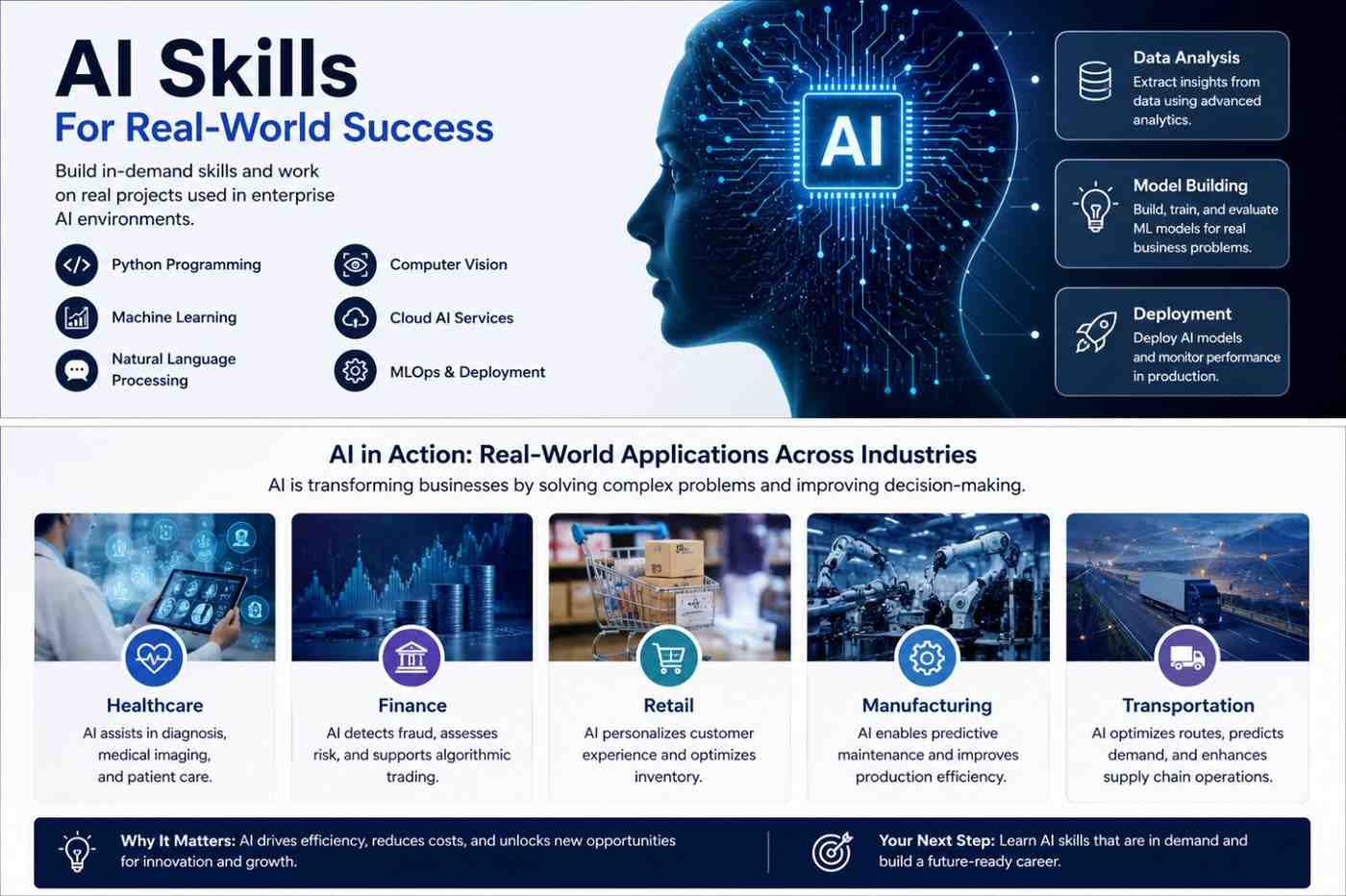
How Is Artificial Intelligence Used in Enterprise Environments?
Enterprise AI implementations focus on solving business problems while maintaining security, compliance, scalability, and reliability.
Customer Service
Applications include:
- AI chatbots
- Virtual assistants
- Ticket classification
- Sentiment analysis
Finance
Common use cases include:
- Fraud detection
- Credit risk assessment
- Financial forecasting
- Transaction monitoring
Healthcare
AI supports:
- Medical image analysis
- Clinical decision support
- Patient risk prediction
- Resource planning
Manufacturing
Organizations use AI for:
- Predictive maintenance
- Quality inspection
- Supply chain optimization
- Production forecasting
Human Resources
AI may assist with:
- Resume screening
- Workforce analytics
- Employee engagement analysis
- Learning recommendations
What Challenges Do Organizations Face During AI Adoption?
Successful AI implementation requires more than building models.
Organizations commonly encounter:
Data Quality Issues
Poor data often leads to poor predictions.
Challenges include:
- Missing records
- Inconsistent formats
- Duplicate data
- Biased datasets
Security and Privacy Requirements
Organizations must protect:
- Customer information
- Financial data
- Proprietary business information
Model Explainability
Business stakeholders often need explanations for AI-generated decisions.
Infrastructure Costs
Large-scale AI workloads may require:
- High-performance computing
- Cloud resources
- Specialized hardware
Governance and Compliance
Organizations must ensure AI systems align with:
- Regulatory requirements
- Internal policies
- Ethical standards
What Job Roles Use AI Daily?
Artificial intelligence supports a wide range of professional roles.
Role vs AI Skills Mapping
| Job Role | Common AI Skills |
|---|---|
| AI Engineer | Model development, deployment |
| Machine Learning Engineer | Training and optimization |
| Data Scientist | Analytics and predictive modeling |
| Data Analyst | Data interpretation |
| Business Analyst | AI-assisted insights |
| Software Engineer | AI integration |
| MLOps Engineer | Deployment and monitoring |
| Product Manager | AI product strategy |
| NLP Engineer | Language model development |
| Computer Vision Engineer | Image processing |
Many professionals transition into AI-related roles from software testing, business analysis, data analysis, and software development backgrounds.
What Careers Are Possible After Learning an AI Course?
Career opportunities vary based on technical depth and specialization.
Entry-Level Opportunities
- Junior AI Engineer
- AI Analyst
- Data Analyst
- AI Operations Associate
- Machine Learning Support Engineer
Mid-Level Opportunities
- Machine Learning Engineer
- AI Engineer
- Data Scientist
- NLP Specialist
- MLOps Engineer
Advanced Opportunities
- AI Architect
- Lead Data Scientist
- AI Product Manager
- AI Solutions Consultant
- Head of AI Initiatives
Career progression typically depends on practical experience, project exposure, and continuous learning.
What Should an AI Course Curriculum Include?
A comprehensive AI training program should cover both foundational and advanced topics.
Recommended Learning Path
| Learning Stage | Topics |
|---|---|
| Foundation | Python, Statistics, Data Analysis |
| Machine Learning | Regression, Classification, Clustering |
| Deep Learning | Neural Networks, CNNs, RNNs |
| NLP | Text Processing, Language Models |
| Computer Vision | Image Recognition |
| Generative AI | LLMs, Prompt Engineering |
| Deployment | APIs, Cloud Integration |
| MLOps | Monitoring and Automation |
| Governance | Ethics, Security, Compliance |
This progression reflects how many enterprise teams develop and deploy AI solutions.
How Do Professionals Apply AI Skills in Real Projects?
Practical learning is essential because AI implementation involves multiple stages beyond model development.
Example Project: Sales Forecasting
Step 1: Define Objective
Predict future sales based on historical performance.
Step 2: Collect Data
Gather:
- Sales records
- Seasonal trends
- Marketing campaign data
Step 3: Prepare Data
Tasks include:
- Cleaning missing values
- Removing duplicates
- Standardizing formats
Step 4: Train Model
Use machine learning algorithms to identify patterns.
Step 5: Evaluate Results
Measure:
- Accuracy
- Precision
- Error rates
Step 6: Deploy
Integrate predictions into dashboards and reporting systems.
Step 7: Monitor
Continuously assess model performance and retrain when necessary.
This workflow reflects common enterprise AI practices.
Best Practices for Learning Artificial Intelligence
Professionals often learn AI more effectively when they combine theory with practical application.
Recommended practices include:
- Learn Python fundamentals.
- Understand data analysis techniques.
- Build small projects regularly.
- Study machine learning concepts.
- Practice with real datasets.
- Learn cloud-based AI services.
- Explore generative AI applications.
- Develop a project portfolio.
- Understand AI ethics and governance.
- Stay updated with industry developments.
Consistency is generally more important than attempting to learn all technologies simultaneously.
Frequently Asked Questions (FAQ)
Is artificial intelligence difficult to learn?
AI can be challenging initially, particularly for learners without programming or data experience. However, structured training and hands-on practice can help professionals build skills progressively.
Do I need a computer science degree to learn AI?
No. Many professionals from business, finance, testing, analytics, and engineering backgrounds successfully learn AI concepts and tools.
Which programming language is most commonly used in AI?
Python is currently the most widely used language due to its extensive AI and machine learning libraries.
How long does it take to learn AI?
Learning timelines vary. Foundational AI concepts may be learned in a few months, while advanced specialization often requires ongoing practice and project experience.
Is machine learning the same as artificial intelligence?
No. Machine learning is a subset of AI that focuses on enabling systems to learn from data.
What industries use AI the most?
Common industries include:
- Healthcare
- Finance
- Retail
- Manufacturing
- Technology
- Telecommunications
- Logistics
Can working professionals learn AI part-time?
Yes. Many training programs are specifically designed to accommodate working professionals through flexible schedules.
Does AI require advanced mathematics?
Advanced research roles may require deeper mathematics. Many practical business applications focus more on implementation and interpretation than theoretical derivations.
Conclusion
Artificial Intelligence has become an important technology across modern enterprises, supporting automation, analytics, decision-making, and innovation. Selecting the best artificial intelligence course training institute in the USA requires evaluating curriculum quality, practical project experience, industry-relevant tools, instructor expertise, and real-world applicability.
Key Takeaways
- AI combines machine learning, data analysis, automation, and decision intelligence.
- Practical project experience is critical for developing job-ready skills.
- Python remains the dominant programming language for AI development.
- Enterprise AI projects require attention to governance, security, scalability, and monitoring.
- AI skills are relevant across technical and business-focused career paths.
- A structured learning path should cover fundamentals, machine learning, deep learning, generative AI, and deployment practices.
Explore IIT Workforce AI training programs to gain hands-on experience with industry tools and practical AI workflows.
Learn through structured projects, expert-led instruction, and career-focused skill development designed for working professionals.