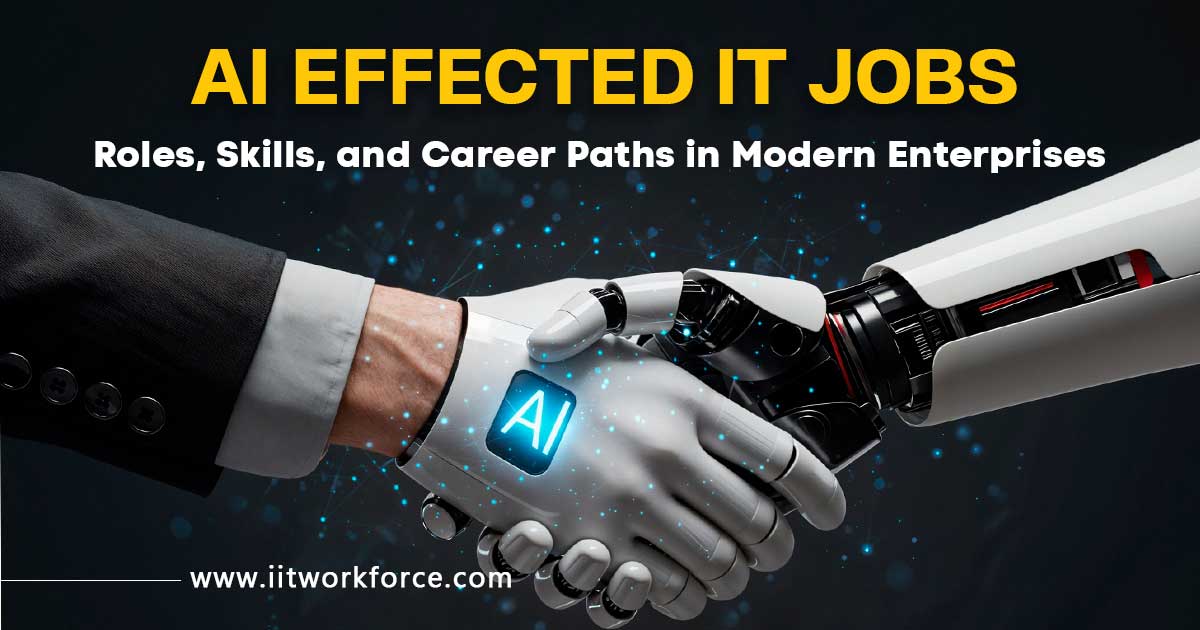
Artificial Intelligence (AI) is actively transforming IT job roles by automating repetitive tasks, augmenting human decision-making, and introducing new technology-driven responsibilities.
Rather than eliminating IT jobs entirely, AI is reshaping how professionals work, requiring updated skill sets and interdisciplinary knowledge across data, automation, and systems engineering.
What is AI Effected IT Jobs?
“AI effected IT jobs” refers to the impact of artificial intelligence technologies on traditional and emerging roles within the IT industry. This impact includes:
- Automation of routine processes (e.g., testing, monitoring)
- Enhancement of decision-making through data analysis
- Creation of new roles focused on AI development and governance
- Evolution of existing roles to include AI-related responsibilities
AI is integrated into various IT domains such as software development, quality assurance, infrastructure management, cybersecurity, and data analytics.
Why is AI Impact Important for Working Professionals?
AI adoption is now common in enterprise IT environments. For working professionals, this shift is relevant because:
- Skill relevance is changing: Traditional roles require AI literacy
- Automation is increasing efficiency expectations
- Cross-functional collaboration is growing (e.g., DevOps + AI + Data teams)
- Decision-making is becoming data-driven
Professionals who understand how AI integrates into workflows are better positioned to adapt to evolving job requirements.
How Does AI Work in Real-World IT Projects?
In enterprise settings, AI is typically implemented as part of a broader system rather than standalone software.
Common AI Workflow in IT Projects
- Data Collection
- Logs, user interactions, system metrics
- Data Preprocessing
- Cleaning, normalization, feature extraction
- Model Training
- Using frameworks like TensorFlow or PyTorch
- Model Deployment
- Integration into APIs or applications
- Monitoring & Optimization
- Performance tracking and retraining
Example Use Case: IT Operations (AIOps)
- AI analyzes system logs
- Detects anomalies in real time
- Predicts failures before they occur
- Suggests remediation steps
How is AI Used in Enterprise IT Environments?
AI is embedded into enterprise systems through various tools and platforms.
Key Use Cases
| Domain | AI Application Example | Tools Commonly Used |
|---|---|---|
| Software Development | Code suggestions, bug detection | GitHub Copilot, SonarQube |
| Testing | Automated test case generation | Selenium + AI plugins |
| IT Operations | Predictive monitoring (AIOps) | Splunk, Dynatrace |
| Cybersecurity | Threat detection, anomaly analysis | Darktrace, IBM QRadar |
| Data Analytics | Predictive insights, forecasting | Power BI, Tableau + ML models |
| Customer Support | Chatbots, NLP-based ticket classification | Dialogflow, Azure Bot Services |
What Job Roles Are Affected by AI?
AI affects both technical and non-technical IT roles.
Roles That Are Evolving
- Software Developers → AI-assisted development
- QA/Test Engineers → Automated testing and validation
- System Administrators → Infrastructure automation
- Data Analysts → Advanced analytics and ML integration
- Business Analysts → Data-driven decision modeling
New Roles Emerging Due to AI
- Machine Learning Engineer
- AI Engineer
- Data Scientist
- AI Product Manager
- AI Ethics and Governance Specialist
Role vs Skill Mapping in AI-Driven IT Jobs
| Job Role | AI-Related Skills Required |
|---|---|
| Software Developer | AI APIs, prompt engineering, automation tools |
| QA Engineer | Test automation, AI validation techniques |
| Data Analyst | Machine learning basics, data modeling |
| DevOps Engineer | MLOps, CI/CD for AI models |
| Cybersecurity Analyst | AI-based threat detection, anomaly detection |
What Skills Are Required to Learn AI?
To adapt to AI-affected IT jobs, professionals need a mix of foundational and advanced skills.
Core Technical Skills
- Programming (Python, R)
- Data Structures and Algorithms
- Statistics and Probability
- Machine Learning Fundamentals
- Data Handling (SQL, Pandas)
AI/ML-Specific Skills
- Supervised and Unsupervised Learning
- Natural Language Processing (NLP)
- Computer Vision (basic understanding)
- Model evaluation and tuning
Tools & Frameworks
- TensorFlow, PyTorch
- Scikit-learn
- Jupyter Notebook
- Cloud platforms (AWS, Azure, GCP)
How Does AI Course Training in USA Help Professionals?
AI course training in the USA is structured to align with enterprise requirements and industry standards.
Typical Learning Path
| Stage | Focus Area |
|---|---|
| Beginner | Python, statistics, basic ML concepts |
| Intermediate | Model building, data pipelines |
| Advanced | Deep learning, NLP, deployment |
| Professional | Real-world projects, MLOps, cloud AI |
Key Features of Structured Training
- Hands-on labs with real datasets
- Exposure to enterprise tools
- Project-based learning
- Integration with cloud platforms
How is AI Applied in Real Project Scenarios?
Scenario 1: Automated Testing in QA
- AI generates test cases from requirements
- Predicts high-risk areas in code
- Reduces manual effort in regression testing
Scenario 2: Predictive Maintenance in IT Infrastructure
- AI monitors server performance
- Identifies patterns indicating failures
- Triggers alerts before downtime occurs
Scenario 3: Intelligent Customer Support
- Chatbots handle routine queries
- NLP classifies tickets automatically
- Reduces response time and workload
Common Challenges in AI Adoption
- Data Quality Issues: Incomplete or inconsistent datasets
- Integration Complexity: Legacy systems may not support AI easily
- Skill Gaps: Lack of trained professionals
- Model Bias and Ethics: Ensuring fairness and compliance
- Scalability: Deploying models efficiently in production
Best Practices Followed in Enterprise AI Implementation
- Use version control for models (MLOps)
- Monitor model performance continuously
- Ensure data privacy and compliance (GDPR, HIPAA)
- Implement CI/CD pipelines for AI deployment
- Maintain clear documentation and audit trails
What Careers Are Possible After Learning AI?
AI learning opens multiple career paths across industries.
Career Options
- AI Engineer
- Machine Learning Engineer
- Data Scientist
- Data Analyst with AI specialization
- AI Solutions Architect
- Automation Engineer
Industry Demand Areas
- Healthcare (predictive diagnostics)
- Finance (fraud detection)
- E-commerce (recommendation systems)
- Manufacturing (automation, robotics)
- IT Services (AIOps, DevOps automation)
Best Place to Learn AI Skills & Best Institute for AI Learning
Choosing the best place to learn AI skills depends on several factors:
Evaluation Criteria
- Curriculum aligned with industry tools
- Hands-on project exposure
- Access to mentors with real-world experience
- Coverage of end-to-end AI workflows
- Flexibility for working professionals
Types of Learning Platforms
| Platform Type | Advantages | Limitations |
|---|---|---|
| Online Courses | Flexible, self-paced | Limited real-time guidance |
| Bootcamps | Intensive, practical | Time commitment |
| University Programs | Strong theoretical foundation | Less flexibility |
| Corporate Training | Real-world alignment | Limited availability |
FAQ: AI Effected IT Jobs
1. Will AI replace IT jobs completely?
No. AI automates specific tasks, but most IT roles evolve rather than disappear.
2. Which IT jobs are safest from AI automation?
Roles requiring complex decision-making, architecture design, and human judgment are less likely to be fully automated.
3. Do I need coding to learn AI?
Basic programming knowledge (especially Python) is typically required for most AI roles.
4. How long does it take to learn AI?
It depends on your background. Typically:
- 3–6 months for basics
- 6–12 months for job-ready skills
5. Is AI course training in USA suitable for beginners?
Yes, many programs start with foundational topics and progress to advanced concepts.
6. What industries are hiring AI professionals?
Healthcare, finance, retail, manufacturing, and IT services are common sectors adopting AI.
Meta Description
AI effected IT jobs explained with roles, skills, career paths, and best place to learn AI skills through structured AI course training in USA.
Key Takeaways
- AI is transforming IT roles by automating tasks and enhancing decision-making
- Existing roles are evolving, and new AI-specific roles are emerging
- Professionals need a mix of programming, data, and machine learning skills
- Enterprise AI adoption involves real-world workflows, tools, and challenges
- Choosing the best institute for AI learning depends on practical exposure and curriculum quality