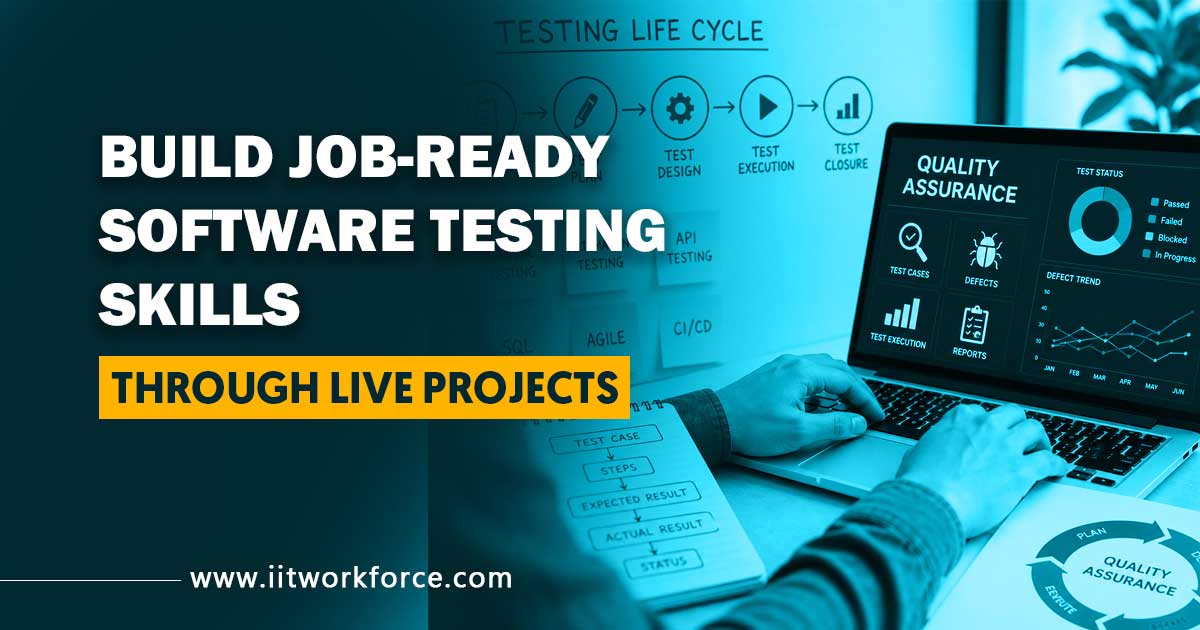

Real-time work experience in IT refers to hands-on exposure to actual project environments, production-like systems, team collaboration workflows, and enterprise-grade tools. It differs from theoretical learning because it involves applying concepts under practical constraints such as deadlines, changing requirements, system limitations, and stakeholder expectations. In fields such as Quality Assurance, Business Analysis, and Selenium automation, real-time experience directly impacts job readiness and long-term career progression.
For professionals exploring online IT Training in USA or IT Live Project Training in USA, understanding how real-time experience translates into workplace competency is essential before choosing a learning path.
What Is Real-Time Work Experience in IT?
Real-time work experience in IT means working on projects that simulate or replicate real enterprise environments. This includes:
-
Working with structured requirements
-
Using production-style tools and repositories
-
Following Agile or Scrum methodologies
-
Managing defects in tracking systems
-
Participating in review cycles and stakeholder discussions
It goes beyond:
-
Watching recorded tutorials
-
Solving isolated coding exercises
-
Practicing only theoretical interview questions
Instead, it involves end-to-end exposure to:
-
Requirement analysis
-
Design documentation
-
Test planning and execution
-
Automation framework development
-
Reporting and retrospective discussions
For learners pursuing IT Training in USA, especially in QA and Business Analysis, real-time exposure bridges the gap between certification and employability.
Why Is Real-Time Work Experience Important for Working Professionals?
Working professionals often transition into IT roles or upgrade their skills while employed. Real-time experience matters because enterprise IT environments are dynamic and collaborative.
Key Reasons
-
Understanding Business Context
-
IT systems serve business objectives.
-
Professionals must align technical decisions with business outcomes.
-
-
Handling Ambiguity
-
Requirements are rarely 100% complete.
-
Teams must clarify, negotiate, and document changes.
-
-
Collaboration Across Teams
-
Developers, QA engineers, BAs, DevOps engineers, and stakeholders work together.
-
Communication and documentation become critical skills.
-
-
Tool Proficiency Under Constraints
-
Version control (Git)
-
Test management tools (JIRA, Azure DevOps)
-
CI/CD pipelines
-
Defect lifecycle tracking
-
Professionals enrolled in IT Live Project Training in USA often gain familiarity with these workflows before entering enterprise roles.
Quality Assurance in Real-World Projects
How Does Quality Assurance Work in Real-World IT Projects?
In enterprise environments, QA is integrated throughout the Software Development Life Cycle (SDLC).
Typical QA Workflow
| Phase | QA Involvement |
|---|---|
| Requirement Analysis | Review BRD/FRD, identify testable scenarios |
| Test Planning | Define scope, strategy, risk analysis |
| Test Case Design | Create positive, negative, edge test cases |
| Execution | Manual and automated test execution |
| Defect Management | Log defects, track status, retest |
| Regression | Validate system stability |
| UAT Support | Assist business users |
QA professionals must:
-
Interpret user stories
-
Validate APIs
-
Perform database validation (SQL)
-
Conduct integration and system testing
-
Support release cycles
Without real-time project exposure, many of these steps remain theoretical.
What Skills Are Required to Learn Quality Assurance?
Core Technical Skills
-
SDLC and STLC knowledge
-
Manual testing techniques
-
Test case documentation
-
SQL for data validation
-
API testing (Postman)
-
Automation basics (Selenium)
-
Defect lifecycle management
Soft Skills
-
Analytical thinking
-
Requirement interpretation
-
Communication clarity
Real-time training environments typically introduce:
-
Sprint-based execution
-
Defect triage meetings
-
Test coverage mapping
-
Traceability matrices
Business Analyst in Enterprise Environments
How Is Business Analysis Used in Real IT Projects?
A Business Analyst (BA) acts as a bridge between business stakeholders and technical teams.
Typical BA Responsibilities
-
Requirement elicitation
-
Stakeholder interviews
-
Creating BRD (Business Requirement Document)
-
Writing FRD (Functional Requirement Document)
-
User story creation in Agile
-
Process modeling (UML diagrams)
-
Gap analysis
-
Supporting UAT
In real enterprise systems, requirements change due to:
-
Regulatory updates
-
Market demands
-
Budget constraints
-
Technical feasibility issues
Professionals learning through online IT Training in USA often require exposure to:
-
Real client scenarios
-
Change request handling
-
Documentation standards
-
Traceability mapping
What Skills Are Required to Learn Business Analysis?
Technical & Documentation Skills
-
Requirement gathering techniques
-
Use case development
-
User story writing
-
JIRA or Azure DevOps
-
UML diagrams (Activity, Sequence, Use Case)
-
Basic SQL understanding
-
Process flow mapping
Enterprise Practices
-
Agile and Scrum methodologies
-
Sprint planning
-
Backlog grooming
-
Acceptance criteria definition
Real-time project experience allows BAs to understand how documentation affects development and testing downstream.
Selenium in Real Enterprise Automation Projects
How Does Selenium Work in Real-World IT Projects?
Selenium is an open-source automation framework used primarily for web application testing. In enterprise environments, it is rarely used in isolation.
Real-World Selenium Stack
-
Selenium WebDriver
-
Java / Python
-
TestNG / JUnit
-
Maven / Gradle
-
Git
-
Jenkins (CI/CD)
-
Page Object Model (POM)
-
Reporting tools (Extent Reports)
Example Enterprise Automation Flow
-
Code written in Selenium WebDriver
-
Structured using Page Object Model
-
Committed to Git repository
-
Integrated with Jenkins pipeline
-
Tests triggered automatically on build
-
Reports generated and shared
Without live project exposure, learners often:
-
Write standalone scripts
-
Ignore framework design
-
Skip CI/CD integration
How Is Selenium Used in Enterprise Environments?
In enterprise systems, Selenium is used for:
-
Regression automation
-
Smoke testing
-
Cross-browser validation
-
Data-driven testing
-
API + UI hybrid validation
Framework Components Table
| Component | Purpose |
|---|---|
| Page Object Model | Maintainable code structure |
| TestNG | Test execution control |
| Data Providers | Parameterized testing |
| Jenkins | Continuous Integration |
| Git | Version control |
| Reporting Tool | Execution insights |
Real-time project training ensures learners understand integration across these tools.
Comparing Classroom Learning vs Real-Time Project Training
| Aspect | Theoretical Learning | Real-Time Project Exposure |
|---|---|---|
| Requirements | Pre-defined examples | Changing, incomplete |
| Tools | Limited practice | Full ecosystem usage |
| Collaboration | Individual | Team-based |
| Debugging | Controlled | Complex environment |
| Documentation | Basic templates | Enterprise standards |
This distinction is important for learners evaluating IT Live Project Training in USA.
What Job Roles Use QA, BA, and Selenium Daily?
QA-Related Roles
-
Manual Test Engineer
-
Automation Test Engineer
-
QA Analyst
-
SDET (Software Development Engineer in Test)
BA-Related Roles
-
Business Analyst
-
Functional Analyst
-
Product Analyst
-
Requirements Analyst
Selenium-Related Roles
-
Automation Engineer
-
QA Automation Developer
-
Test Framework Engineer
These roles require not only tool knowledge but workflow understanding.
What Careers Are Possible After Learning QA, BA, or Selenium?
Career Path: Quality Assurance
-
Junior QA Analyst
-
QA Engineer
-
Senior QA Engineer
-
QA Lead
-
QA Manager
Career Path: Business Analyst
-
Junior BA
-
Business Analyst
-
Senior BA
-
Product Owner
-
Product Manager
Career Path: Automation Engineer
-
Automation Tester
-
Senior Automation Engineer
-
SDET
-
Automation Architect
Progression often depends on practical experience rather than certification alone.
Common Enterprise Challenges Without Real-Time Experience
-
Difficulty understanding requirement ambiguity
-
Poor defect documentation
-
Inability to design scalable automation frameworks
-
Weak stakeholder communication
-
Limited exposure to production constraints
Real-time training environments aim to simulate:
-
Agile sprint cycles
-
Code reviews
-
Automation integration
-
Change request workflows
How Professionals Apply These Skills in Live Projects
Example: QA Scenario
-
Requirement: Payment gateway update
-
QA Action:
-
Review updated acceptance criteria
-
Create new test cases
-
Validate database entries
-
Execute regression suite
-
Report defects with logs
-
Example: BA Scenario
-
Requirement: Add new user onboarding feature
-
BA Action:
-
Conduct stakeholder meeting
-
Draft process flow
-
Define user stories
-
Clarify edge cases
-
Support UAT
-
Example: Selenium Scenario (Pseudo Workflow)
Navigate to application URL
Locate login field
Enter credentials
Click submit
Validate dashboard load
Log result
In enterprise environments, this script becomes part of:
-
Framework structure
-
CI/CD pipeline
-
Regression suite
Frequently Asked Questions (FAQ)
1. Is real-time experience mandatory to get an IT job?
Not always mandatory, but it significantly improves job readiness and interview confidence.
2. Can online IT Training in USA provide real-time exposure?
Yes, if the program includes live projects, sprint-based workflows, and tool integration practice.
3. Is Selenium enough to become an automation engineer?
Selenium alone is insufficient. Knowledge of frameworks, version control, and CI/CD tools is necessary.
4. Do Business Analysts need technical knowledge?
Yes. While not developers, BAs benefit from understanding databases, APIs, and Agile tools.
5. What is IT Live Project Training in USA?
It typically refers to structured training programs that simulate real project environments using enterprise tools and workflows.
6. How long does it take to gain practical competency?
This varies, but structured project-based learning accelerates practical skill acquisition.